
Practical, CPD-accredited training for people who support others through grief and loss
Supporting Grief Well: The Grief Map Approach
Grief affects far more than emotion. It can change how someone thinks, communicates, makes decisions, relates to other people and manages everyday life. What they need may be shaped by the circumstances of the loss, their identity, culture, relationships, previous experiences and the support available around them.

Supporting Grief Well: The Grief Map Approach gives you a practical framework for making sense of that complexity. You will learn how to notice what may be shaping someone’s experience, ask more useful questions and respond with greater confidence.
£60 · CPD-accredited · Physical Grief Map included · Self-paced learning and a live tutor session
See how the Grief Map works
In this short video, Martin Roddis, co-founder of Elephants in Rooms, takes you through the Grief Map and explains the thinking behind it.
A physical copy of the Grief Map is included when you enrol on Supporting Grief Well: The Grief Map Approach. The course gives you the knowledge and practical guidance needed to use it thoughtfully and confidently during real conversations.
Already taken the course, or need additional copies for your work? You can also buy the Grief Map separately for £15
The idea of mapping grief is not new. For decades, one model has shaped how people expect grief to unfold.
What are the five stages of grief – and do they happen in order?
Denial, anger, bargaining, depression and acceptance are commonly known as the five stages of grief.
The model was introduced by psychiatrist Elisabeth Kübler-Ross in her 1969 book On Death and Dying, drawing on her work with people who were facing their own deaths. It was not created as a sequence that every bereaved person must pass through.
Over time, however, the five stages have often been presented as a predictable journey: beginning with denial, moving through a series of emotional stops and eventually arriving at acceptance.
Real grief is not that cooperative or tidy.
Some people may recognise some of these experiences. Others may recognise all of them, none of them or something quite different. They may experience anger without denial, acceptance alongside sadness, or emotions that do not appear anywhere in the model. There is no required order, and acceptance is not a finishing line. The difficulty is not that these experiences have been named. It begins when we turn them into expectations about how somebody ought to grieve.
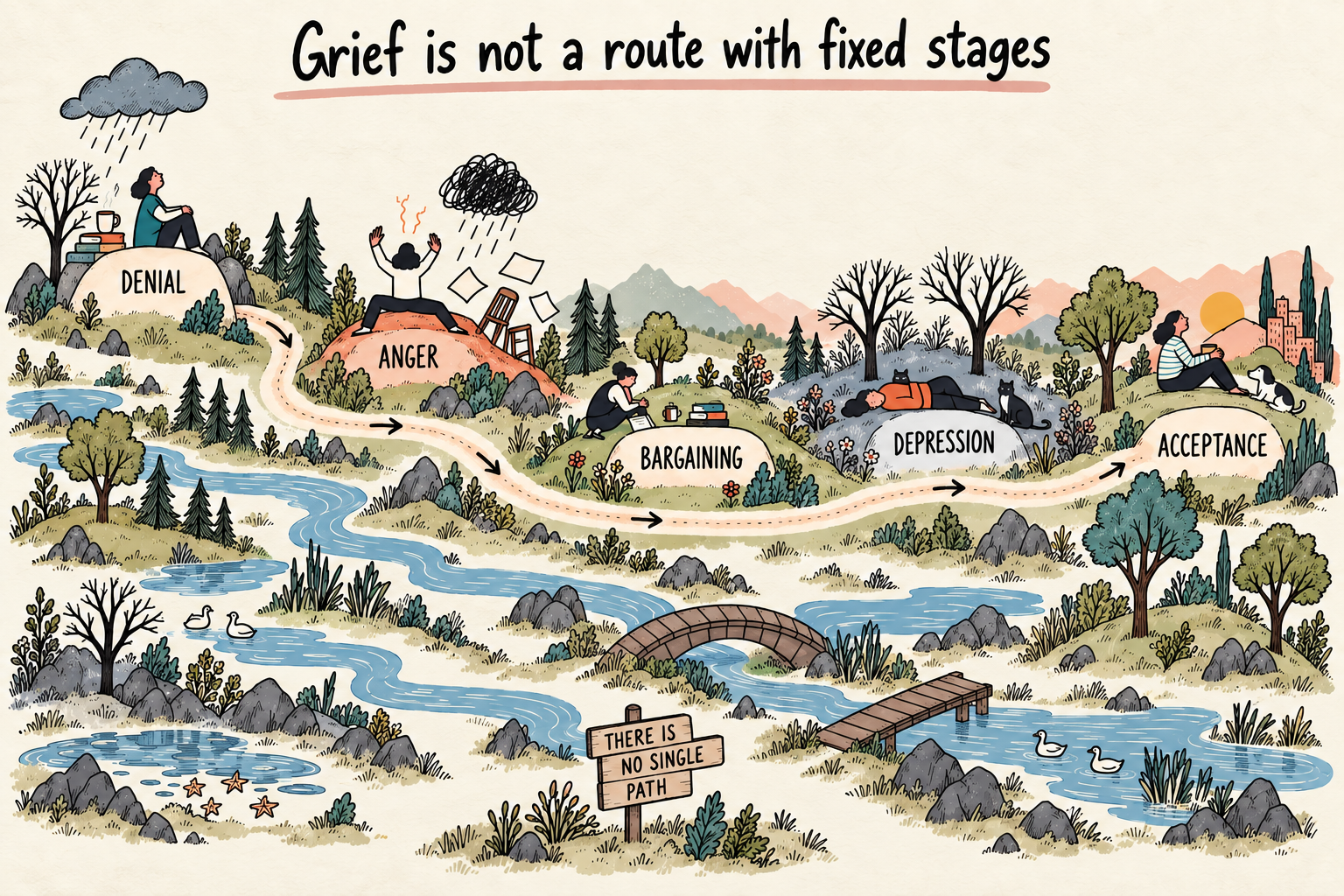
If grief does not follow stages, what can a map do?
The appeal of a map is understandable. When grief feels overwhelming or difficult to make sense of, people want something that can help them find their bearings. The problem is not wanting a map. It is being given one that assumes the route in advance.
The Grief Map starts from a different place. It does not tell you which stage somebody is in or what should happen next. Instead, it helps you explore what has been lost, what has changed and what may be happening across the person’s thoughts, emotions, body, relationships, identity and everyday life. It gives you a practical framework for remaining curious, asking more useful questions and considering what kind of support might genuinely help the person in front of you.
Supporting Grief Well: The Grief Map Approach is designed to give you both a strong understanding of grief and practical ways to use that understanding when supporting another person. It helps you consider the circumstances surrounding the loss, the support available around the person and the things that may be making their grief harder to carry.
In the full course you will explore:
- How grief can affect thoughts, emotions, the body and behaviour
- What neuroscience tells us about the grieving brain
- Why having continuing bonds with the person who has died is healthy
- Grief models like the Dual Process, which help people make sense of what they are going through (you can explore this in the free taster module)
- Intrusive thoughts and helpful or unhelpful rumination
- Practical needs and self-care during grief
- Trauma responses and the Window of Tolerance
The course is designed to help you build your understanding gradually, with materials you can revisit when you need them.
What does the training include?
Your enrolment includes:
A physical Grief Map posted to you
Self-paced online learning
Videos, written resources and practical guidance
Reflective activities and knowledge checks
Continued access to the course materials
A 60–90-minute tutor-led online session after the self-paced learning
A CPD certificate following completion
Ready to feel more confident supporting people through grief?
Enrol for £60 and receive the complete self-paced course, a physical Grief Map, a live tutor session and your CPD certificate.
Frequently Asked Questions
Who is this grief training course for?
The course is suitable for anyone whose work or volunteering brings them into contact with grief, bereavement or significant loss, including:
Counsellors and psychotherapists
Mental health professionals
Funeral professionals
Healthcare and care staff
Bereavement volunteers and peer supporters
Financial services professionals
Managers, HR teams and workplace wellbeing leads
Charity and community workers
You do not need to work in a specialist bereavement role. Grief appears in all kinds of professional conversations, often without announcing itself first.
Can you buy the Grief Map without taking the course?
Yes. The physical Grief Map is available as a standalone resource.
You can keep it close at hand as a visual prompt for reflection and conversations about grief. It may be useful if you already understand the approach, want an additional copy or need more maps for your work.
The standalone map does not include the teaching, practical guidance or tutor-led session provided by the complete course.
Who teaches the Grief Map course?
The course is taught by Martin Roddis and Trudie Bamford.
Martin has created and delivered grief education for organisations across healthcare, blue-light services, financial services, charities and community support. He created Cruse Bereavement Support’s Grief First Aid course.
Trudie is a trainer and therapist with particular experience in traumatic grief, including bereavement following suicide and drug-related death, as well as neurodivergence and grief.
Together, they connect established grief theory with the reality of supporting actual people.
Can you provide Grief Map training for teams and organisations?
Yes. The Grief Map Approach can be delivered or adapted for your team or organisation.
We provide live workshops, webinars, digital learning and supporting resources shaped around the situations your people encounter. Tell us who the training is for, what they are facing and what you would like them to feel more confident understanding or doing.
Discuss Grief Map training for your organisation