
IN DEPTH
ADHD and grief: how can ADHD affect the way we grieve?
Listen to Trudie and Martin read this article. Press play below and read along, or just settle in and listen.
Grief can make concentration disappear, routines fall apart, emotions feel unpredictable and ordinary tasks strangely difficult.
ADHD can affect concentration, working memory, emotional regulation, organisation, task initiation and our sense of time.
Put the two together and things can get complicated.
That doesn’t mean there is a particular “ADHD way” to grieve. Two people with ADHD can experience the same kind of loss completely differently. The relationship that was lost, the circumstances of the loss, previous experiences, other things happening in life, personality, support and countless other factors all matter.
But ADHD can influence what grief feels like, how it is expressed and what becomes harder when someone is grieving.
For some adults with ADHD, familiar difficulties become considerably louder. Things they could normally just about keep on top of suddenly become much harder. Emotions may arrive with enormous intensity, or seem oddly absent for a while. A person may be functioning remarkably well one day and unable to begin a fairly ordinary task the next.
None of this tells us how much somebody loved the person they lost. And none of it tells us whether they are grieving “properly”.
There really isn’t a useful prize for Most Convincingly Bereaved Person.
How does ADHD affect grief?
The simplest answer is that grief happens through the brain you already have.
Some of the things commonly associated with ADHD can interact with the demands grief places on the brain and body.
Research in adults with ADHD has identified differences across areas including attention, working memory, inhibition, executive functioning and emotional regulation. Grief itself can also affect attention, memory, decision-making and cognitive functioning.
So somebody who already spends quite a lot of mental energy remembering what they are doing, getting themselves started, switching attention or keeping several things in mind may suddenly be attempting all of that while their brain is also dealing with a major loss.
Things that were difficult can become very difficult, and things that were manageable can become unexpectedly unmanageable.
That is often the most useful way to understand ADHD and grief: not as a separate kind of grief, but as grief interacting with the person’s existing neurology.
A note about the research:
There is very little research looking directly at ADHD and grief together.
A 2024 systematic review (Mair and colleagues, 2024) found 39 sources about grief across neurodevelopmental conditions, but ADHD appeared in only one research study and one piece of grey literature, and wasn’t the main focus of either.
So this page draws together what we know from ADHD research, what we know from grief research, and what neurodivergent people describe from lived experience.
That gives us a useful picture, but not a definitive one. Some of the connections below are plausible rather than proven, simply because the direct research hasn’t been done yet.
Do people with ADHD grieve differently?
Sometimes. But not in one predictable direction.
One person with ADHD may experience enormous waves of emotion. Another may feel surprisingly calm and begin to worry that something is wrong with them. Someone else may disappear into practical jobs. Another might struggle to do anything at all.
A person might also move between all of these.
Lived-experience accounts describe grief that feels fragmented or uneven, including periods in which the loss is not prominent in awareness followed by moments when it suddenly feels painfully immediate again.
The important question isn’t, “Is this how people with ADHD grieve?”
A better question is, “How is this particular person’s ADHD interacting with this particular loss?”
That leaves considerably more room for an actual human being.
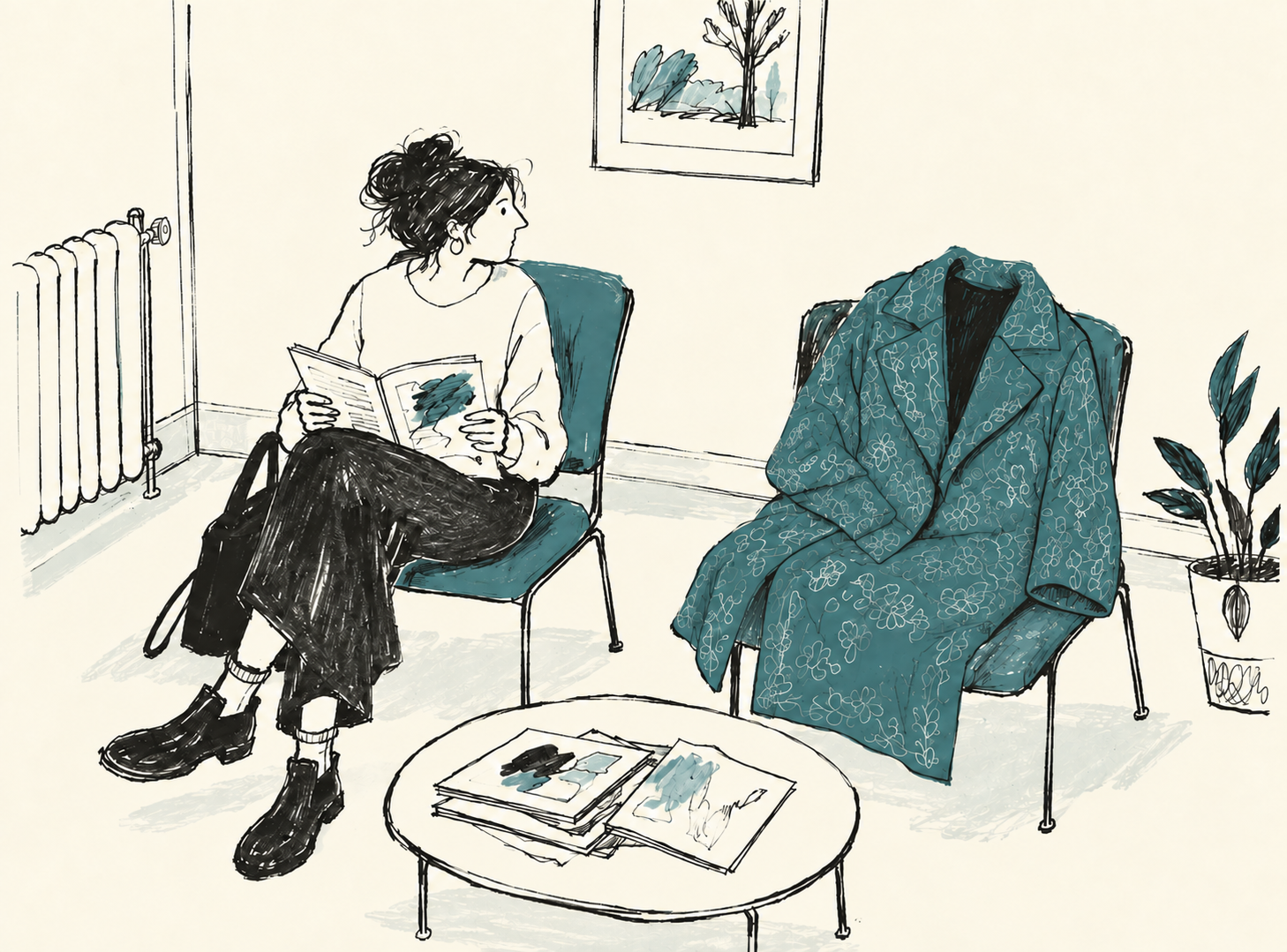
When grief makes everyday functioning harder
Can grief make ADHD symptoms worse?
People often describe it that way.
A bereavement doesn’t necessarily change somebody’s underlying ADHD. But the stress, emotional demands, disruption and cognitive load of grief can leave less capacity available for everything else.
ADHD research already tells us that many people have difficulties with working memory, attention, planning and inhibition, although the pattern varies enormously from person to person.
Grief can put pressure on many of the same things. Concentration, memory, attention and decision-making can all become harder after a bereavement.
Which creates a fairly obvious problem with capacity. If your brain was already doing quite a lot of invisible work to keep everyday life running, grief has just handed it another job. A rather enormous one.
You may therefore notice more forgetfulness, poorer concentration, more difficulty starting things, increased disorganisation, stronger emotional reactions or less ability to shift attention.
That does not necessarily mean ADHD has permanently become “worse”. It may mean the resources you normally use to manage it are currently being used elsewhere.
Why does grief make it harder to concentrate?
Because grief occupies attention even when you aren’t consciously sitting there thinking about your loss.
There may be memories, practical problems, changed routines, worries about other people, legal or financial responsibilities, disrupted sleep and dozens of tiny reminders requiring the brain to repeatedly update itself to a changed reality.
People commonly describe “grief brain”: forgetting why they walked into a room, rereading the same paragraph, losing track of conversations or finding decisions unexpectedly difficult.
For somebody with ADHD, that may be landing on top of existing differences in attention and working memory.
Working memory is particularly relevant. It is the system that allows us to hold information in mind temporarily while doing something with it. Meta-analytic research has found moderate working-memory differences between groups of adults with ADHD and control participants, while also making clear that ADHD is highly variable and not every individual shows the same pattern.
In everyday grief, this may look less like an interesting neuropsychological construct and more like standing in the kitchen holding an unopened tin and having absolutely no idea what the original plan was.
Can grief affect executive functioning?
Yes. And this is one of the places where ADHD and grief can become a particularly awkward double act.
Executive functions help us plan, organise, prioritise, remember what needs doing, switch between tasks, make decisions and actually start the thing we have decided to do.
Grief can place extraordinary demands on precisely these skills.
After a death, there may suddenly be phone calls, funeral arrangements, forms, financial decisions, messages, possessions to sort, appointments to remember and other people’s questions to answer.
For adults with ADHD who already experience executive-function difficulties, the additional load can be substantial. Research consistently associates ADHD with differences across several executive and cognitive domains, although these differences are neither universal nor identical in everyone with ADHD.
This matters for supporters.
Knowing and doing are not the same neurological task.
Why can everyday tasks become so difficult?
Grief removes spare capacity.
Task initiation is already a familiar problem for many people with ADHD. Starting an activity requires the brain to select it, inhibit competing activity, organise the sequence and create enough momentum to begin.
Now add exhaustion, emotional distress and thirty-seven new things that apparently need doing by Tuesday.
This is why support sometimes needs to become much more concrete.
“Let me know if you need anything” sounds generous, but requires the grieving person to identify a need, decide who can help, formulate a request, contact them and possibly overcome the fear of being a nuisance.
“I can bring dinner on Thursday or do the supermarket run. Which would be more useful?” has removed most of the executive work.
That small difference can be enormous.
Why can routines become harder after a bereavement?
A loss doesn’t only remove a person. It can dismantle a system.
The person who died may have been part of how the day worked. They might have prompted appointments, made dinner, driven somewhere, paid a bill, sent the reminder, initiated social plans or simply provided the rhythm around which everyday life was organised.
This can be particularly significant where somebody with ADHD has developed routines, shared systems and external reminders that quietly support their executive functioning.
Bereavement may therefore create secondary losses that are not immediately obvious.
You haven’t only lost Dad. You’ve lost the person who rang every Sunday.
The person who reminded you about birthdays. The place you went every Christmas. The reason Tuesday evenings looked the way Tuesday evenings looked.
Grief support can miss these losses when it concentrates entirely on emotion. Sometimes the broken routine is part of the grief.
What does “time blindness” mean for ADHD and grief?
“Time blindness” is an informal term commonly used to describe difficulties perceiving, estimating or managing time.
There is research suggesting differences in aspects of time perception and time management in adults with ADHD, but the evidence is limited and mixed. Some studies find clear differences; others don’t. So time processing may be relevant for some people with ADHD, but it isn’t an inevitable ADHD trait.
In grief, time is odd enough without any additional help. A death may feel simultaneously like yesterday and another lifetime.
Someone with ADHD may find anniversaries arrive before they have mentally registered that they are approaching. They may struggle to answer questions such as “How long has it been?” or discover that an unexpected reminder brings the loss sharply into the present again.
Lived-experience accounts from people with ADHD sometimes describe periods when the person who died isn’t particularly present in attention, followed by a reminder which makes their absence feel abruptly real again.
The internet sometimes calls this an ADHD problem with object permanence. Strictly speaking, it isn’t. Object permanence is the developmental understanding that something continues to exist when it cannot be seen.
“Out of sight, out of mind” may be useful shorthand for an attentional experience, but it shouldn’t be dressed up as a settled neurological explanation for grief.
Emotions, attention and uneven grief
Can grief make emotions more intense when you have ADHD?
For many people, yes. Emotional regulation is increasingly recognised as an important part of the ADHD picture for many adults. A meta-analysis of 13 studies involving 2,535 participants (Beheshti and colleagues, 2020) found substantially higher levels of emotional dysregulation in adults with ADHD than in control groups, while later reviews have also stressed that this area is complex and findings are not completely uniform.
Grief, meanwhile, can bring sadness, anger, guilt, fear, relief, yearning, numbness and irritation, sometimes within an impressively short period of time.
For someone who already experiences emotions quickly or intensely, grief may therefore feel particularly forceful.
But intensity is only one possibility. ADHD grief does not have to be dramatic.
A person can also be quiet. Practical. Distracted. Productive. Numb. Funny. Apparently fine.
Periods of not feeling the grief intensely do not make the grief less real.
Nor does emotional intensity tell us that someone loved more deeply than somebody whose grief is quieter.
Why can grief seem to arrive in bursts?
Attention does not sit still.
For some people with ADHD, one experience becomes completely absorbing while everything outside it temporarily recedes. At other times attention may shift rapidly.
Attention probably matters here, but this is one of the places where the research runs out. There simply aren’t enough direct ADHD-and-bereavement studies to support the idea of a distinct “ADHD grief cycle”.
What people describe in real life is often much less orderly:
Someone can be fully occupied by work, a practical task or an absorbing interest and genuinely feel okay.
Then a song plays.
A message appears.
They find the person’s handwriting.
And grief occupies the whole room again.
Neither state is false. Grief has not been switched off during the first one, and the second does not mean the person has gone backwards.
What about rumination and getting stuck on thoughts?
Grief naturally generates questions…
What happened?
Could I have done something differently?
Why didn’t I notice?
What if?
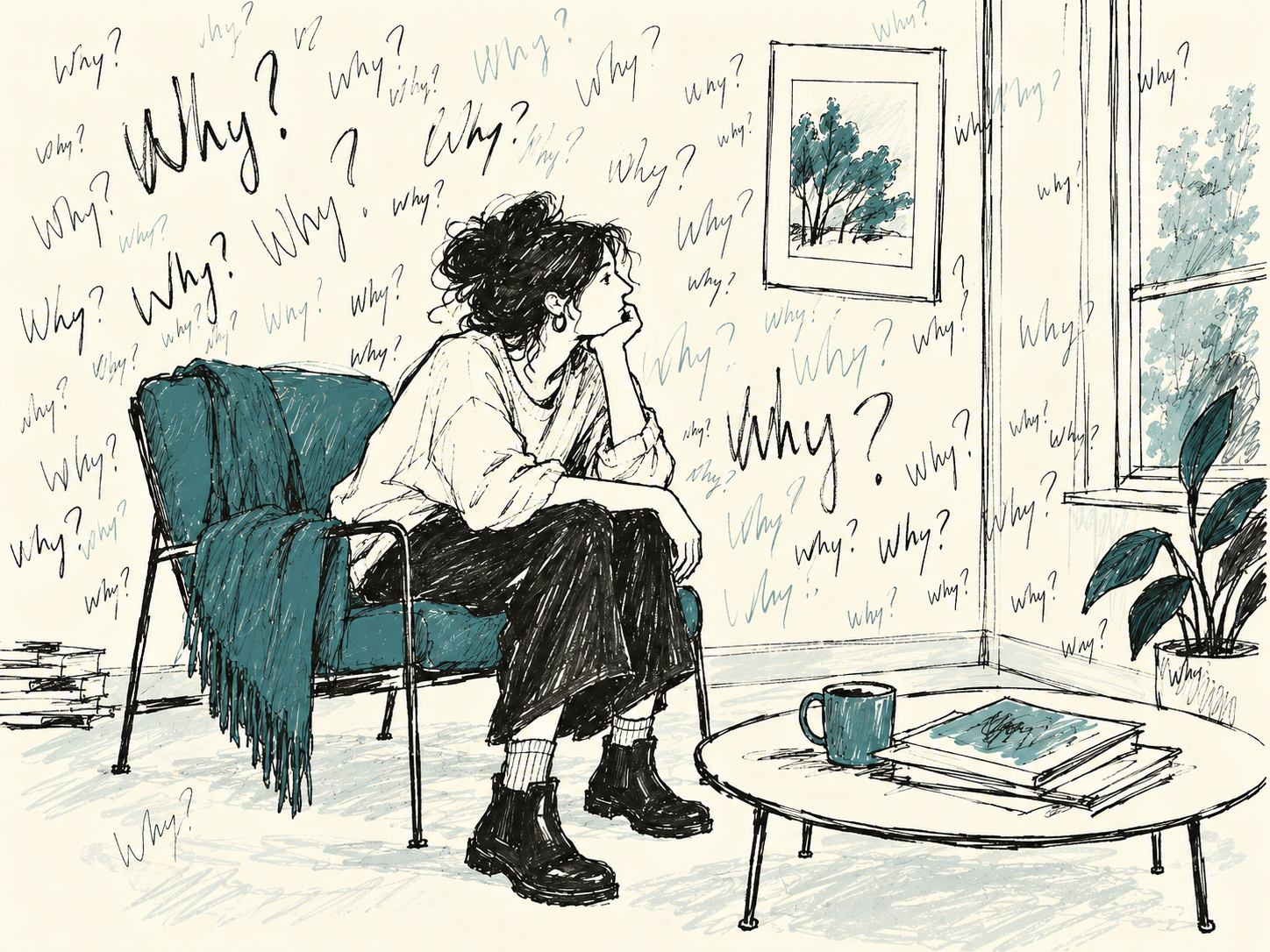
ADHD can also make it harder to redirect attention once it has latched onto something. That doesn’t make repetitive grief thinking uniquely “ADHD”, but it may make some questions particularly sticky.
And repetition isn’t automatically a problem. Grief often involves going back over what happened, replaying events or returning to the same questions as we try to make sense of the loss.
What matters more is what the thinking is doing.
Are they gradually making sense of what happened? Or are they trapped in exactly the same question with increasing distress and no new information?
Support shouldn’t automatically try to stop repetitive thinking. Sometimes it is grief processing. Sometimes it is a stuck loop.
The difference matters.
Listen to our podcast episode on helpful and unhelpful rumination on Grief In the Room.
Can grief be delayed or uneven when you have ADHD?
Grief is uneven whether somebody has ADHD or not. People do not steadily become 4% less bereaved every week until they are ‘better’.
Some people feel the impact immediately. Others function almost automatically at first. Practical demands can take over. Shock may dominate. Emotion may arrive later.
ADHD may add another layer because attention and emotional intensity can fluctuate, but there is no established pattern of “delayed ADHD grief”.
So if somebody says:
“I know they’re dead. I just don’t feel it all the time.”
That does not need correcting.
Nor does:
“I was fine for three months and now I’m falling apart.”
We should be very wary of deciding when another person’s grief was supposed to turn up.
When grief doesn’t look the way people expect
Can sensory overload make bereavement harder with ADHD?
For some people, yes.
Sensory processing differences aren’t exclusive to autism. A 2025 systematic review and meta-analysis (Jurek and colleagues, 2025) involving more than 5,000 participants found more sensory differences across several areas in people with ADHD, although there was considerable variation between studies.
That matters because bereavement can be spectacularly unfriendly to an overloaded nervous system.
Funerals and wakes may involve crowds, unfamiliar clothes, physical contact, flowers, perfume, music, crying, lengthy conversations, disrupted food and sleep, and a steady procession of people who would quite like to hug you.
Someone needing to step outside, move around, avoid physical contact, wear headphones on the journey or leave early isn’t necessarily avoiding grief. They may simply be trying to remain in the room without becoming completely overwhelmed.
Can someone with ADHD look as though they are coping when they are not?
Very easily.
People often judge grief from the outside. Are they crying? Are they talking about the person? Have they gone back to work? Do they seem “normal”?
Unfortunately, external appearance is a fairly poor grief-measuring device.
Some adults with ADHD also describe hiding or compensating for difficulties in order to meet social expectations. Research into ADHD masking is still developing, but qualitative studies do describe people working hard to appear more organised, capable or socially at ease than they feel internally.
During bereavement, that might mean somebody continues working, answers the necessary messages and handles the funeral while becoming increasingly depleted behind the scenes.
It can also work the other way. Grief may remove the energy normally used to compensate. Someone who previously appeared extremely organised may suddenly start missing appointments or deadlines. Someone who managed social situations reasonably well may begin withdrawing. Emotional reactions that were previously hidden may become more visible.
Sometimes what looks like deterioration is simply capacity running out.
Does impulsivity affect grief?
Potentially. ADHD research finds differences in inhibitory control at group level, but that doesn’t mean impulsivity will shape everybody’s grief.
During intense distress, somebody who already finds it difficult to create a pause between impulse and action may find that harder than usual.
That could show up in quick decisions, impulsive spending, abruptly contacting someone, acting before thinking something through or using something in the moment to escape overwhelming emotion.
It’s more useful to treat impulsivity as one possible factor when a grieving person says their decision-making feels very different from usual.
What about ADHD and other kinds of loss?
Grief isn’t restricted to bereavement.
People can grieve the end of a relationship, loss of health, redundancy, retirement, infertility, a change in identity, the loss of a home, a friendship ending or a future they expected to have.
A relationship ending may remove structure as well as companionship. Job loss may remove routines that were doing far more regulatory work than anyone realised. A diagnosis may change somebody’s understanding of their past. Moving house may remove environmental cues and systems that helped everyday life run.
This is one reason we use loss as well as bereavement when talking about grief.
What matters is the impact of the loss, not whether it fits neatly into a recognised category.
How can you support someone with ADHD who is grieving?
Good ADHD-aware grief support doesn’t require an elaborate new therapeutic technique. Quite often it requires us to remove unnecessary demands.
Useful support might include:
For professionals and employers, the same principle applies.
Reduce unnecessary cognitive load. Put important information in writing. Give clear priorities. Be realistic about deadlines. Make adjustments based on what the individual says is difficult rather than what grief is supposed to look like.
Most importantly, don’t turn neurodivergent behaviour into evidence that somebody is grieving incorrectly.
When might extra support help?
Grief can knock ordinary life badly out of shape. Concentration disappears, sleep goes strange, emotions can be unpredictable and things that were easy a month ago can suddenly take enormous effort. None of that, on its own, tells us that something is wrong.
A more useful question is what is happening to the person’s everyday life. Are they managing to eat, sleep, take medication, look after children, get through work or stay connected to other people? Are existing mental-health difficulties becoming much harder to manage? If everyday life is becoming unmanageable, or the person would like some help with it, extra support may be useful.
The aim isn’t to make somebody grieve more normally. It is to make life a little more manageable while they find their way through what has happened.
For somebody who is neurodivergent, the picture can be harder to untangle. Grief may be interacting with ADHD, autism, alexithymia, sensory or communication differences, existing mental-health difficulties, or several things at once. A neat label rarely explains the whole person.
It is also why a question as ordinary as “How do you feel?” isn’t always as straightforward or helpful as it sounds. . We explore that in more detail in the article Why “How do you feel?” isn’t always the right question, which looks at alexithymia and grief.
Understanding neurodivergent grief more fully
If you want to understand this in more depth, our Neurodivergence & Grief course is designed for therapists, healthcare professionals, bereavement supporters, employers and others whose work involves supporting grieving people.
It looks beyond individual diagnoses to explore how neurodivergence can shape the experience and expression of grief, and what that means when you’re actually sitting with another person. We cover cognitive load, executive functioning, emotional regulation, sensory needs, communication, masking and grief theory, with role-play scenarios showing how these differences can turn up in real conversations.
Recognising that people grieve differently is the easy bit.
Knowing what to do differently is where the important work begins.
If you’re worried about someone’s immediate safety
If you or someone else is in immediate danger, call 999 or go to A&E. If you need urgent help for your mental health, you can call NHS 111 or use NHS 111 online.
You can also call Samaritans free on 116 123, any time, day or night. If talking on the phone feels difficult, you can text SHOUT to 85258 for free, confidential, 24/7 text support in the UK.
References:
Beheshti, A., Chavanon, M.-L. and Christiansen, H. (2020) Emotion dysregulation in adults with attention deficit hyperactivity disorder: a meta-analysis. BMC Psychiatry, 20, 120. https://doi.org/10.1186/s12888-020-2442-7
Jurek, L. and colleagues (2025) Sensory processing in individuals with attention-deficit/hyperactivity disorder compared with control populations: a systematic review and meta-analysis. Journal of the American Academy of Child and Adolescent Psychiatry. https://doi.org/10.1016/j.jaac.2025.02.019
Mair, A. P. A. and colleagues (2024) Understanding the neurodiversity of grief: a systematic literature review of experiences of grief and loss in the context of neurodevelopmental disorders. Review Journal of Autism and Developmental Disorders. https://doi.org/10.1007/s40489-024-00447-0