
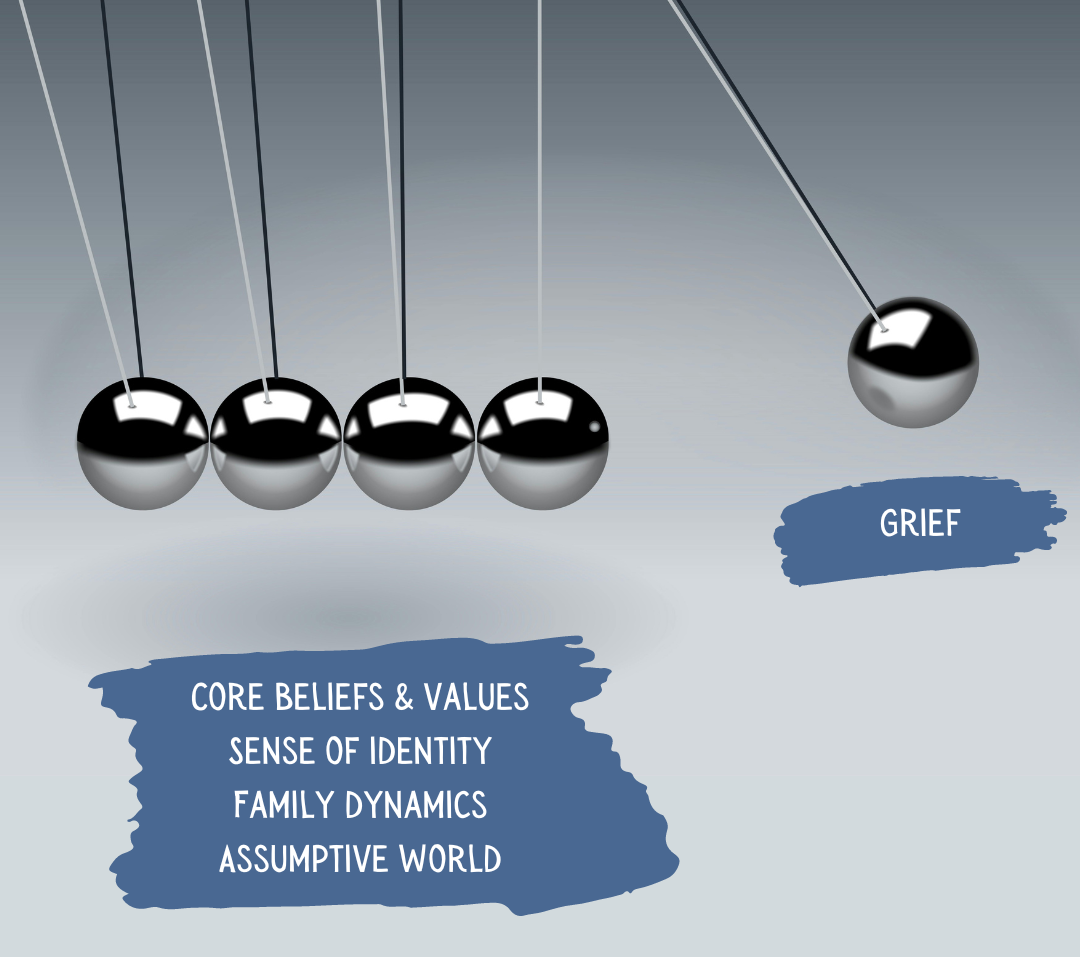
Grief impacts every aspect of your life. Your body, your emotions, your routines, your cognition, grief bleeds into it all, like a drop of ink in a glass of water.
But it goes much deeper than that.
We live in a world that we’ve carefully constructed, from our earliest age. Its foundation is our family system, where we fit into it, what our relationship was like with our caregivers. On top of that, our identity gets built. Who we are, where we belong, what roles we take, our coping strategies, our behaviours, our attitudes; all those go into our framework. And how we see our world, whether it is safe or unsafe, how we expect to be treated, the way we believe life will unfold. We take all that and we build our personal experience of life. We make decisions based on it, we plan around it, we live within its constructs, good or bad. Life would be chaotic and confusing and unpredictable without that.
And then someone important to us dies. Or we experience or witness something so shocking that the trauma plunges us into its own kind of grief. A chain reaction has now been set off. The grief hits every aspect of our carefully constructed world, until everything you thought you knew is in flux. You are powerless to stop this, once it’s set in motion. This particular Newton’s Cradle is the size of the universe, and you are a teeny tiny speck.
This is why simplistic views of grief fall so far of the mark. Grief is not a set of tidy stages that you can move through. It is too far reaching and lifechanging for that.
This is why there is a need for many grief models. Each of them contributes something to our understanding of how grief works, and the reconstruction process that we have to go through to rebuild our world from the fragments of the old. And this is why there is a need for skilled, knowledgeable, experienced grief therapists, who have curious minds, keep up to date with scientific & academic developments, and approach their clients with an open mind.
Grief becomes a catalyst for understanding yourself and your world. Part of the meaning-making work we do as we grieve is looking at the world we constructed, and seeing which parts we want to keep, and which parts we need to change.